Many leaders reach a point where the team is clearly working hard, yet performance is not improving in proportion to the effort being invested. Calendars are full, communication is constant, and multiple initiatives move forward at once. From the outside, the organization appears active and committed.
Despite that intensity, results level off. Revenue holds steady. Client satisfaction plateaus. Margins remain under pressure. The effort is visible, yet the impact feels muted.
When this pattern emerges, the instinct is to push harder. The issue, however, is rarely motivation. More often, it reflects a gradual shift from outcomes to activity, where busyness becomes the proxy for contribution.
High-tempo environments reinforce this shift. When urgency and responsiveness are consistently rewarded, motion begins to feel like progress. Meetings, updates, and coordination signal engagement, even when measurable improvement is limited. Hybrid work has amplified this dynamic. With visibility reduced, leaders increase touchpoints to stay aligned, and interaction expands without necessarily sharpening accountability.
The gap between effort and ownership widens.
Activity Without Ownership
Many organizations collaborate well but lack precision around accountability. Teams contribute broadly, yet when outcomes stall, ownership is unclear.
Not all interaction creates value. When decision-making, problem-solving, and information sharing blur together, discussions drift and decisions resurface without closure. Everyone feels involved, but few feel directly responsible for the metric.
Activity increases because participation is visible. Accountability weakens because ownership is diffused.
When results stall, three questions cut through:
Are outcomes clearly defined beyond task completion?
Is ownership explicitly assigned?
Are interactions designed to drive decisions, or simply share updates?
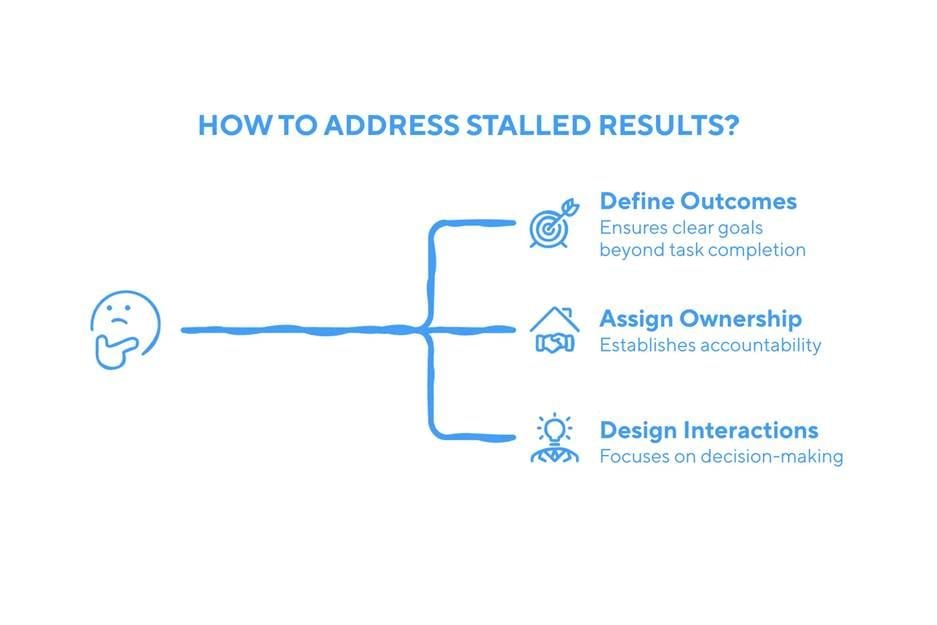
Without clarity, teams default to effort.
Resetting Accountability Without Blame
Hard-working teams do not need criticism. They need alignment.
Begin by separating tasks from outcomes. Completing deliverables does not guarantee improvement. Shift reviews from “What did we do?” to “What changed?”
Examine tempo as well. Constant urgency leaves little room for prioritization. Eliminating low-value interactions and protecting focused work often produces more impact than launching another initiative.
Finally, make ownership visible. Effective leadership sets targets, defines guardrails, assigns responsibility, and allows execution.
Before asking the team to work harder, ask:
Are we measuring activity or impact?
Do we know who owns each critical outcome?
Hard work should drive progress. When it does not, the structure surrounding the work deserves attention.
Sustainable performance depends on clear accountability and disciplined focus on what actually moves the needle.
———
Sources:
https://hbr.org/2025/07/new-research-on-why-teams-overwork-and-what-leaders-can-do-about-it