Trust in leadership does not grow from communication alone. It grows from understanding.
In most organizations, leaders believe they are communicating frequently. Updates are shared, meetings are held, and new initiatives are announced. Yet teams often walk away from those conversations with very different interpretations of what they just heard.
The issue is rarely a lack of information. More often, it is a lack of clarity.
When people do not fully understand the priorities, direction, or reasoning behind decisions, they begin filling the gaps themselves. And once that happens, alignment starts to fracture. Different teams move in different directions, even when they believe they are supporting the same strategy.
Over time, trust begins to weaken, not because leadership is silent, but because the message never fully landed.
Clarity Creates Shared Meaning
Effective leadership communication is not about volume or frequency. It is about whether people interpret the message in the same way.
When communication is clear, teams can describe priorities using similar language. They understand what the organization is trying to achieve and how their work contributes to that direction. This shared understanding creates confidence because people know what matters and how to move forward.
Without that clarity, even well-intentioned communication can create confusion. Messages travel across the organization, but they begin to fragment as people interpret them through their own assumptions.
Research consistently shows how common this problem is. In many organizations, only a small portion of employees strongly believe their leaders have a clear direction for the business. The gap between leadership intent and employee understanding is often wider than leaders realize.
When Messages Don’t Land
Organizations frequently measure communication through activities such as town halls, updates, leadership meetings, or engagement surveys. While these tools can show whether communication is happening, they do not always reveal whether people truly understand the message.
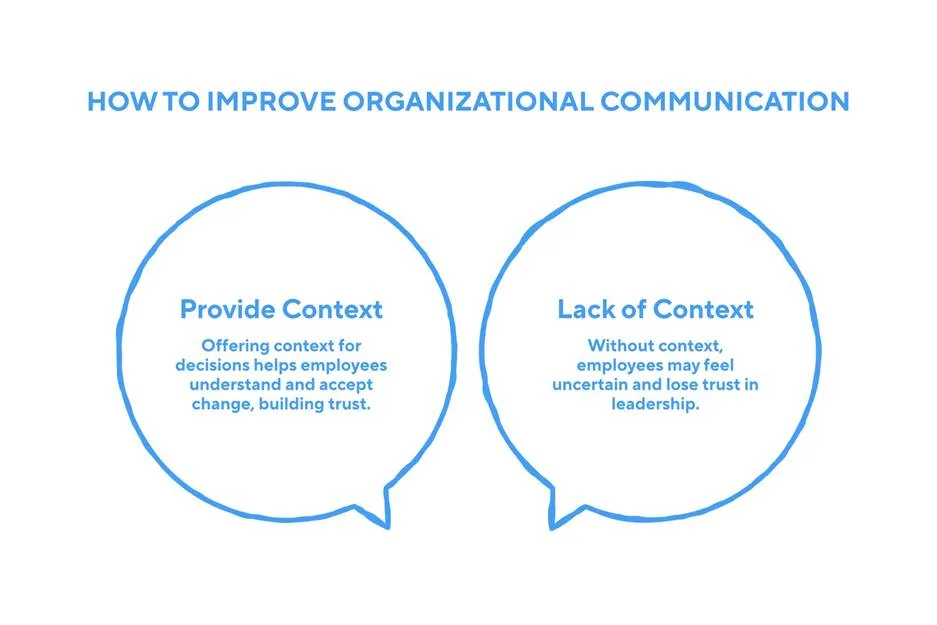
The real challenge of leadership communication is helping people make sense of what is happening inside the organization. When leaders provide context for decisions, employees can interpret change more confidently. When that context is missing, teams may know that something is changing but remain unclear about what it means for them.
That uncertainty can quietly erode trust.
When people cannot explain the organization’s direction or how their work contributes to it, they begin to question whether leadership itself has that clarity.
Clarity Signals Competence
Clear communication sends a powerful signal about leadership capability.
When leaders express ideas in a way that is simple, focused, and easy to understand, teams interpret that clarity as evidence of thoughtful decision-making. Clear direction suggests that leaders have taken the time to understand the problem and define the path forward.
Ambiguity sends the opposite signal. When priorities are overly complex or messages feel scattered, people begin to question whether leadership truly understands the strategy itself.
This is why clarity builds trust so quickly. It allows people to see both the direction and the thinking behind it.
Turning Clarity Into Trust
Clarity does not require perfect communication skills. It requires discipline.
Leaders build clarity when they define priorities before announcing them. They explain why decisions are being made, not just what decisions were made. They connect strategy to the daily work of the people responsible for carrying it forward.
Most importantly, they repeat the message long enough for it to become shared understanding.
When teams understand what matters and why it matters, engagement tends to follow naturally. People align more easily, decisions move faster, and strategy becomes easier to execute.
In many ways, trust grows from a simple foundation.
People trust leaders who make the direction clear enough for everyone to move forward together.
———
Sources:
https://hbr.org/2022/03/to-win-over-an-audience-focus-on-building-trust