Credibility is one of the most valuable forms of leadership capital a person can have. It is also one of the easiest to lose.
Most leaders do not lose credibility because of one dramatic mistake. More often, it erodes through small behaviors that create doubt over time. A decision feels inconsistent. A message changes depending on the audience. A leader asks for trust but does not demonstrate the same level of transparency, discipline, or care in return.
These moments may seem minor on their own, but teams are always interpreting what leadership behavior means. Over time, those interpretations shape whether people believe a leader is worth following.
At its core, credibility rests on two beliefs. People need confidence that a leader is capable of doing the job well, and they need to trust that the leader’s judgment, values, and follow-through are dependable. When either belief weakens, credibility starts to slip.
Credibility Is Built in the Everyday
Leaders often think credibility is established through vision, confidence, or major decisions. In reality, it is built much more quietly.
People watch how leaders communicate under pressure. They notice whether priorities stay steady or shift without explanation. They pay attention to whether decisions reflect the values leadership claims to stand for. They remember whether leaders listen, whether they follow through, and whether they make the work clearer or more confusing.
This is why credibility rarely disappears all at once. It weakens through repeated signals that make leadership feel less consistent, less grounded, or less trustworthy than it first appeared.
Where Credibility Starts to Break Down
One of the fastest ways leaders lose credibility is by creating confusion around what matters most. When everything is positioned as a priority, teams stop believing leadership has made real choices. The organization stays busy, but people begin to question whether anyone is steering with discipline.
Credibility also weakens when leaders become overly attracted to the next idea, initiative, or opportunity. Innovation matters, but constant movement without sustained follow-through can make leadership look reactive rather than intentional. Teams become hesitant to commit when experience tells them the direction may change again before the work has time to take hold.
A third pattern is quieter but just as damaging: expecting the organization to run on extra effort instead of sound design. When leaders rely on employees to stretch beyond reasonable limits just to keep performance stable, they signal something important without meaning to. Over time, people start to question not only the system, but the judgment behind it.
The Behaviors Teams Read Immediately
Some credibility gaps show up in places leaders overlook.
A careless relationship with people’s time is one of them. When teams are pulled into unnecessary meetings, slowed down by inefficient systems, or forced to absorb preventable friction, they notice. People may not describe it as a credibility issue, but that is often what it becomes. Wasted time suggests weak prioritization, limited awareness, or a lack of respect for how work actually gets done.
Another common issue is disconnect from the middle of the organization. Senior leaders may focus on vision at the top and motivation at the front lines while overlooking the managers who understand operational reality best. When those voices are left out of change efforts, skepticism spreads quickly. Teams can sense when ambition and execution are out of sync.
Then there is misalignment. Few things erode credibility faster than a gap between what leadership says and what the organization experiences. If the strategy calls for innovation but the culture punishes risk, people notice. If the brand promises one thing while operations deliver another, trust weakens. Misalignment teaches teams not to take leadership language seriously.
Credibility Is Rebuilt Through Evidence
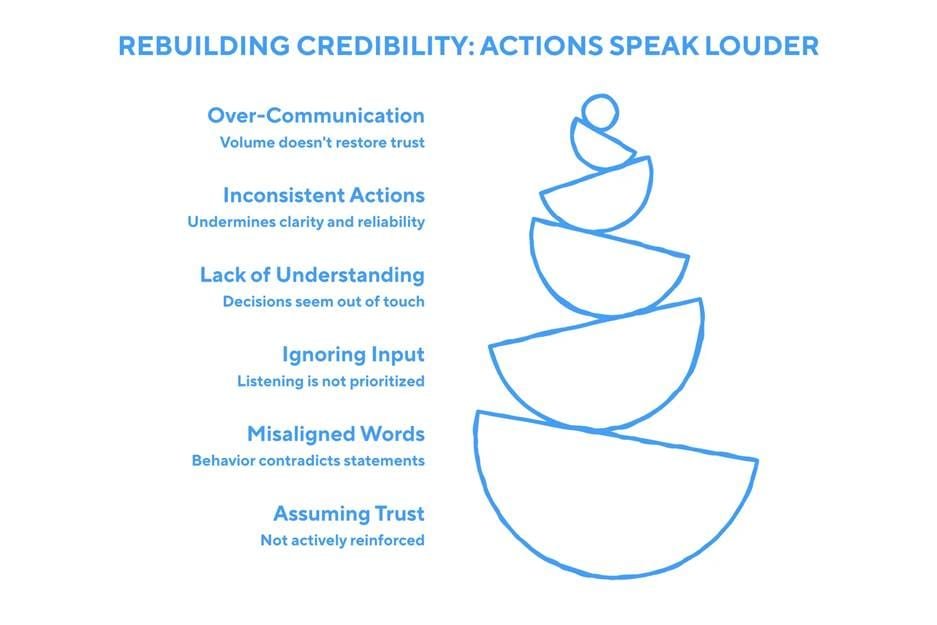
When credibility weakens, many leaders respond by communicating more. More updates. More framing. More reassurance.
But credibility is not restored through volume. It is restored through evidence.
Leaders rebuild credibility when their actions become easier to trust. That means making clearer choices, staying consistent long enough for those choices to produce results, and showing that decisions are grounded in real understanding of the business and its people. It means listening before announcing, aligning words with behavior, and treating trust as something that must be reinforced through practice rather than assumed through position.
The strongest leaders understand that credibility is not about being flawless. It is about being believable.
Belief forms when people can see, over time, that leadership is clear in its thinking, honest in its communication, and disciplined in its follow-through.
So what are your actions showing your team right now? Are they reinforcing your credibility, or quietly weakening it?
———
Sources:
https://sloanreview.mit.edu/article/why-people-believe-in-their-leaders-or-not
https://hbr.org/2020/05/begin-with-trust
https://hbr.org/2023/10/10-pitfalls-that-destroy-organizational-trust