Right now, Marketing is facing a credibility test inside many leadership teams. Companies are investing real money into campaigns, platforms, and content, yet leadership teams are increasingly uneasy about what that spend is actually producing. The metrics move, but the growth does not always follow in a meaningful way.
When returns disappoint, the instinct is to adjust tactics. Change the agency. Test new creative. Refine targeting. Add another channel. The issue is treated as an execution gap.
Often, it is a clarity gap.
Marketing struggles when the organization has not articulated a specific, credible promise to the customer. Without that foundation, campaigns can generate awareness and short-term engagement, but they rarely build sustained preference. Visibility can be purchased. Credibility must be earned.
Research into brand performance consistently shows that campaigns anchored in a clear customer promise outperform those built around general claims or creative impact alone. The difference is not media sophistication or spend. It is whether the communication defines what the customer can expect and whether the company is structured to deliver it.
A real promise creates accountability. It tells the customer what will happen if they choose you. When that promise is concrete, it builds trust. When it is vague, it dissolves into background noise.
Many businesses fall into that trap. In an effort to appear comprehensive, they communicate features, capabilities, and differentiation all at once. Everything may be accurate, yet none of it answers the question that drives a decision: what, exactly, am I getting, and why should I believe you?
In uncertain markets, that question becomes sharper. Customers are more selective and less patient. They are not looking for clever messaging. They are looking for clarity and reliability.
This is also why marketing leaders are under pressure to demonstrate return on investment. Boards are right to ask what the spend is producing. The solution is not to abandon brand building in favor of short-term performance tactics. It is to ensure that communication is anchored in a promise strong enough to shape the entire customer experience.
When product, sales, and service are not aligned around the same commitment, marketing becomes decoration rather than direction. Customers sense the disconnect quickly, and no amount of optimization can compensate for it.
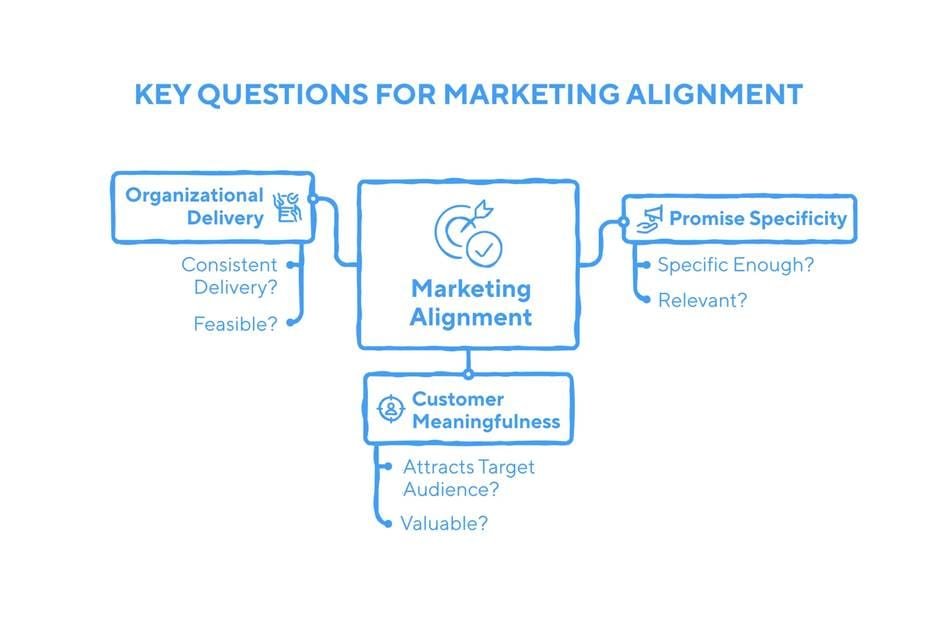
Before increasing spend, leadership should step back and examine the premise.
What are we actually promising?
Is it specific enough to matter?
Is it meaningful to the customer we want to attract?
Can the organization consistently deliver on it?
When those answers are unclear, more marketing only amplifies confusion.
Marketing still works. What fails is messaging that tries to impress instead of commit, that aims for reach before earning trust, and that speaks about the company rather than defining what the customer can depend on.
In uncertain markets, the clearest promise wins.
———
Sources:
https://hbr.org/2024/01/the-right-way-to-build-your-brand