There is a moment, usually sometime around June, when a team looks up and realizes the business does not quite feel like itself anymore.
Nothing dramatic happened. No pivot, no crisis, no single bad call. Just months of responding without anyone stopping long enough to ask whether the work still connects to what the organization actually set out to do.
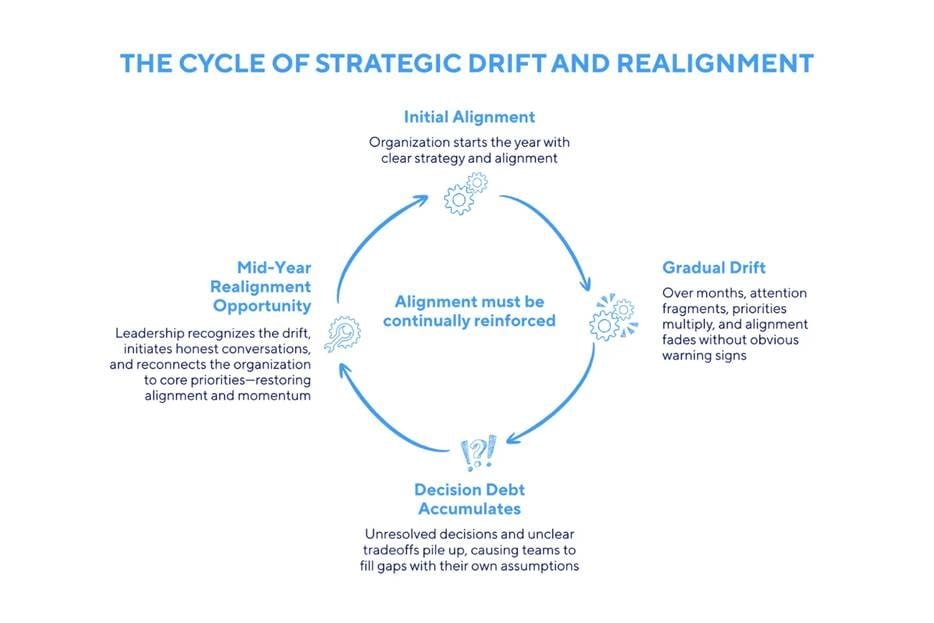
That kind of drift is insidious precisely because it does not announce itself. The company still looks productive from the outside. But somewhere underneath all that motion, execution starts feeling heavier than necessary.
The organization keeps operating, but with less cohesion than before.
Harvard Business Review recently noted that many leaders treat alignment as something established once rather than something that must be continually reinforced. But alignment fades faster than most organizations realize. And once it fades, teams begin pulling in slightly different directions, each confident they are still following the plan.
That is how strategy becomes decoration.
The Cost Nobody Budgets For
Strategic drift rarely looks like failure from the inside. That is what makes it expensive.
Research from In Parallel found that misaligned execution can cost organizations between 5 and 10 percent of annual revenue, while only about one in five employees believes leadership communicates strategy clearly and consistently.
The problem is not effort. It is attention becoming fragmented across too many competing priorities at once. And when every priority feels pressing, teams start making their own quiet version of the strategy.
The business keeps moving. But it is no longer moving in one direction.
How Decision Debt Builds
There is another piece of this that does not get talked about enough: what happens when organizations stop making clean decisions.
Not the big ones. Those usually get made eventually. It is the middle-tier decisions that pile up. The tradeoff that got acknowledged but never resolved. The initiative that was never fully approved or fully killed. The structural issue everyone knows needs attention but keeps getting deferred until there is time to deal with it properly, and that time rarely comes.
Thomas McCorry, writing in Behind the Metrics, frames it well: strategy defines intent, but decisions create momentum.
When decisions do not get made, momentum does not pause. It turns.
Teams fill the vacuum with their own assumptions, and those assumptions quietly become the operating strategy, whether leadership intended them to or not.
By the second half of the year, leadership teams often find themselves spending more time coordinating and recalibrating than actually moving forward.
Pulling the Organization Back Together
The good news is that drift is recoverable.
The organizations that maintain that focus through the year are not the ones that never got pulled off course. They are the ones disciplined enough to keep reconnecting the business back to what matters most.
An honest conversation about priorities, held now rather than in Q4, costs very little. The same conversation held after another quarter of fragmented execution costs considerably more.
Mid-year is not too late. In many organizations, it is exactly the right time to stop and reconnect around what matters most.
The strategy is usually still sound. It just needs the organization to recommit to it.
———
Sources:
https://www.pwc.com/gx/en/news-room/press-releases/2026/pwc-2026-global-ceo-survey.html
https://www.deloitte.com/us/en/insights/topics/talent/human-capital-trends.html
https://hbr.org/2026/04/how-to-convince-your-boss-they-need-a-coach
https://hbr.org/2026/01/what-leaders-get-wrong-about-strategic-alignment
https://www.in-parallel.com/insight/the-real-cost-of-strategic-drift