Organizations that consistently outperform do so by turning direction into disciplined, repeatable action, not by having the most ambitious strategies.
They move quickly from idea to implementation. Priorities show up in daily work, not just on paper. Progress is visible, decisions are straightforward, and momentum grows. What sets them apart is steady action, not just planning.
Strategy sets direction.
Accomplishment comes from what follows.
Action, not activity, moves strategy forward
Many organizations stay busy but do not make real progress. There is more work, more meetings, and more projects. People put in effort, but results are mixed when work is not linked to clear goals.
What needs to happen now? Which decision will help us move forward? What should we accomplish by the end of this week or month?
Accomplishment comes from actions that drive change.
Start with the edges
Think of a puzzle. You do not start in the middle. You start with the edges.
The borders define the structure, showing what the picture is and where each piece fits. Without them, pieces might connect, but the whole picture doesn’t come together.
For a business, the “edges” are its main priorities and things that cannot be changed. These guide how teams work together over time. When these are clear, decisions line up easily. When they are not, work gets scattered.
Clear “edges” create consistency without slowing down action.
Reinforce priorities through decisions
Execution is determined by the decisions that are made under pressure.
When time is short and there are many demands, you see what matters most by the trade-offs you make. The issue is not effort, but where it is applied.
- What are we choosing not to do?
- Which initiatives directly support our core priorities?
- Where are we spreading effort too thin?
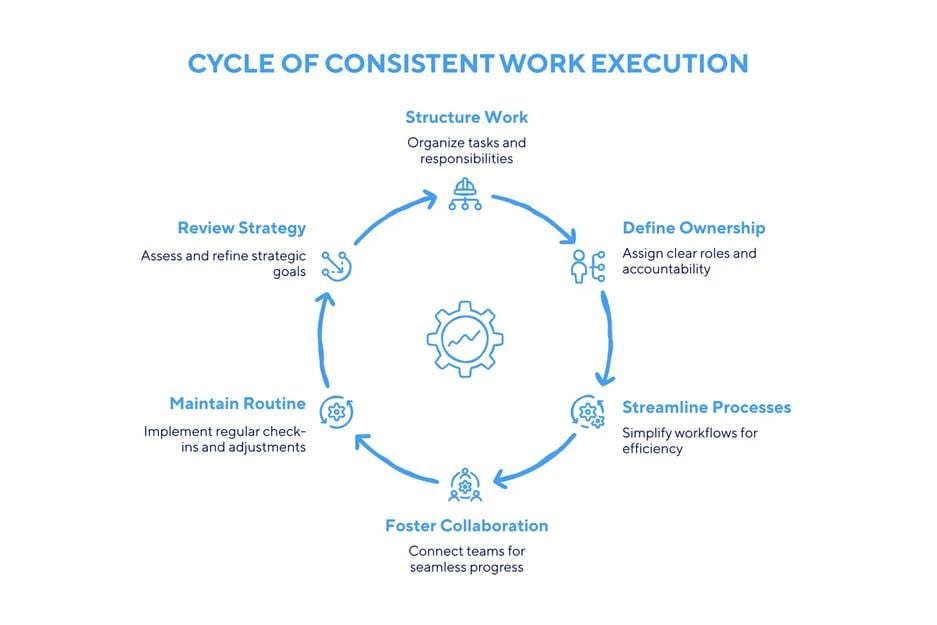
Build execution into how the organization operates
Consistency relies on how work is structured and maintained over time, not just how it is managed in the moment.
When it is not clear who owns what, progress slows. When decisions require too many approvals, momentum stalls. Work continues, but it fragments instead of compounding. These are not small issues; they determine whether execution holds under pressure or breaks down.
Organizations that follow through on their strategy revisit it consistently, resolve issues quickly, and adjust priorities as conditions change. This is not a separate review; it is part of daily work.
A clear operating rhythm keeps strategy active, sustains focus, and prevents progress from drifting.
These are not just optimizations; they are conditions that make execution possible.
Strategy becomes accomplishment through consistency
The organizations that achieve what they set out to do are not defined by their plans. They are defined by how they act.
They translate direction into immediate steps, make choices that support their main goals, and keep things moving.
Results are not occasional; they are expected.
———
Sources:
https://hbr.org/2026/01/when-strategy-and-execution-fall-out-of-sync
https://hbr.org/2026/01/to-execute-a-unified-strategy-leaders-need-to-shadow-each-other