Most strategies don’t fail when they’re being defined, but when it’s time to put them into action. As more people get involved in making decisions, even the best strategies can lose their focus; not because the direction is unclear, but because the connection between priorities and decisions fades over time.
The challenge is not execution, but connection.
As organizations grow, strategy is distributed across teams, functions, and regions. Decisions are made closer to the work, often with good intent and local context. Without a consistent link to shared priorities, those decisions begin to drift, and teams stop reinforcing each other’s work.
The organization does not slow down; it fragments.
Disconnection is a decision problem
When workstreams disconnect, the problem isn’t a lack of effort. It’s that decisions are no longer tied to common priorities.
Each team moves forward based on its own context, making trade-offs without visibility into how they affect the broader organization. Over time, these choices compound, leading to overlapping, misaligned, or conflicting work.
Research from Harvard Business Review shows this same pattern. A recent HBR study found that 75% of cross-functional teams struggle, often because decisions are made in silos and teams focus on their own outcomes rather than shared goals.
The result is not inactivity, but inefficiency.
When workstreams stay disconnected
Disconnected teams don’t always look like they’re struggling.
Projects move forward, and teams hit their targets, but outcomes don’t come together in a meaningful way.
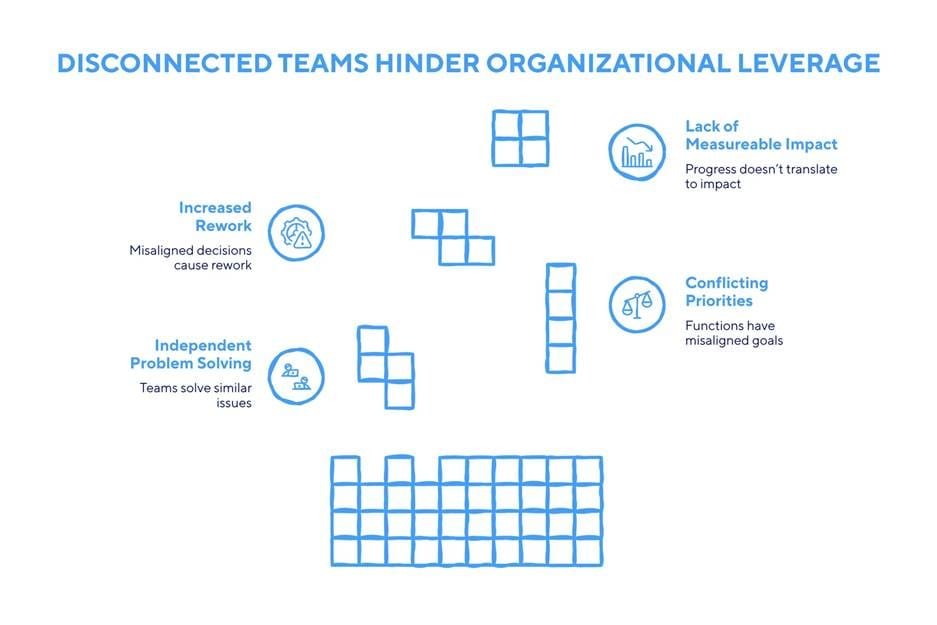
This is where the organization loses leverage:
- Teams solve similar problems independently.
- Priorities conflict across functions.
- Rework increases due to misaligned decisions.
- Progress does not translate into measurable impact.
The value of coming back together
Decentralization increases speed, but alignment requires regular reconnection.
Leaders need space to step back from day-to-day work, compare how decisions are being made, and identify where priorities are starting to diverge. Settings like team meetings or group coaching can create that visibility.
Without it, fragmentation continues. With it, teams stay aligned without slowing down.
Connecting priorities to decisions
The challenge isn’t defining strategy, but ensuring it shapes decisions consistently across the organization.
This requires clarity in how decisions are made at every level. Priorities must translate into action, and trade-offs must follow a consistent logic so that work reinforces, rather than competes.
With that connection in place, decentralization creates scale rather than division.
The difference is not in how the strategy is written.
It is whether the organization can keep its work connected as it grows.
———
Sources:
https://hbr.org/2025/03/3-types-of-silos-that-stifle-collaboration-and-how-to-dismantle-them
https://hbr.org/2015/06/75-of-cross-functional-teams-are-dysfunctional
https://hbr.org/2026/04/when-silos-hinder-innovation-and-when-they-can-help