Trust rarely disappears overnight. More often, it fades through a series of small moments that seem insignificant on their own but meaningful when they accumulate.
A decision is announced without context. A new initiative appears before the last one has had time to take hold. Priorities shift, yet the reasoning behind those shifts remains unclear.
From the leadership perspective, these moments often reflect adaptation. Leaders are responding to new information, changing market conditions, or emerging opportunities. But from the team’s perspective, the experience can feel different. When direction changes faster than explanation, people begin to question whether the organization truly knows where it is going.
And when that uncertainty grows, trust begins to erode.
What Teams Are Actually Looking For
Trust inside an organization is not built through slogans or vision statements. It forms through the signals employees look for in leadership every day.
First, people want to know that leadership understands their reality. When teams believe their challenges and pressures are recognized, they feel respected.
Second, they need confidence in the leadership’s capability. Teams watch closely to see whether decisions are thoughtful and grounded in a clear understanding of the business.
Third, people need consistency. When leaders say one thing and follow through, credibility builds over time. When words and actions diverge, trust weakens quickly.
When these signals are present, trust grows naturally. When one begins to wobble, the shift is usually felt across the organization.
Where Trust Begins to Break Down
In many organizations, trust does not collapse because of a single failure. It erodes through everyday leadership patterns that create confusion.
Organizations that pursue too many priorities at once often struggle to show teams what actually matters. When everything feels important, progress slows, and direction becomes harder to trust.
Trust can also weaken when new initiatives repeatedly replace unfinished ones. Innovation is important, but when strategies change faster than results appear, teams begin to question whether leadership will stay committed long enough for real progress.
Even smaller signals contribute to this erosion. When employees feel their time is wasted by unnecessary meetings or inefficient systems, they begin to wonder whether leadership truly understands how work gets done.
Individually, these patterns may appear operational. Collectively, they shape how people interpret leadership’s care, capability, and consistency.
Rebuilding Trust Through Leadership Behavior
Trust is rarely restored through messaging alone. It grows through behavior.
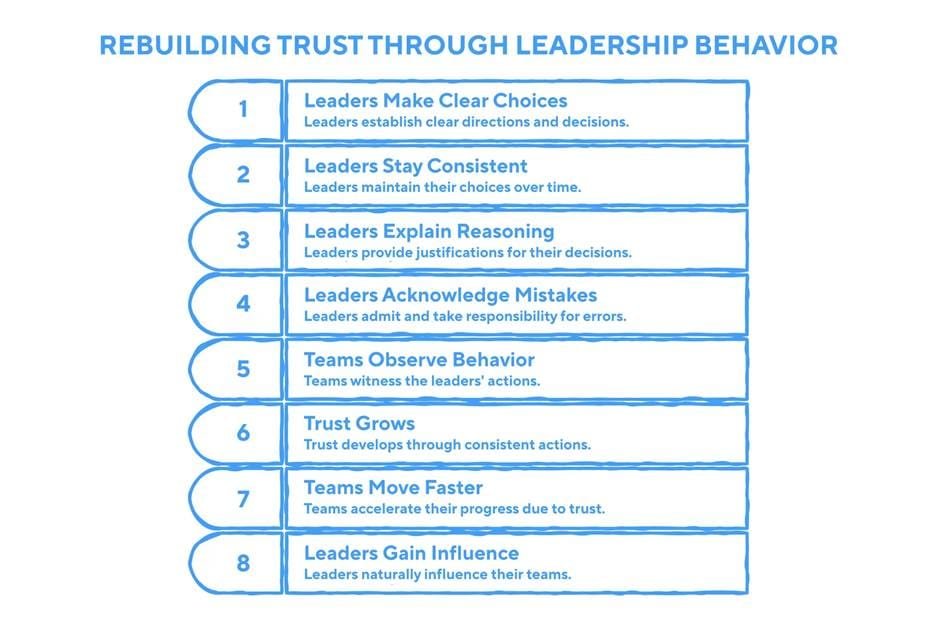
Leaders rebuild trust when they make clear choices and stay consistent long enough for those choices to produce results. It strengthens when leaders explain the reasoning behind difficult decisions and openly acknowledge mistakes.
Over time, these actions reinforce what teams are looking for: leadership that understands their reality, can navigate challenges, and follows through.
When those signals are present consistently, trust becomes a powerful accelerator. Teams move faster because they spend less time questioning direction and more time contributing to it.
And eventually, leaders no longer have to persuade people to follow them.
Trust does that work for them.
———
Sources:
https://hbr.org/2023/07/how-to-build-trust-at-work-our-favorite-reads
https://hbr.org/2023/10/10-pitfalls-that-destroy-organizational-trust