Strategies rarely break at the start. They weaken over time.
Direction is set, priorities are communicated, and work begins with focus. But as execution unfolds, that connection starts to loosen. Some initiatives move forward, others stall, and over time the link between what was planned and what actually happens begins to fade.
Data from Forbes reflects the pattern. Most strategies are not fully realized, with as many as 90% never carried through to completion.
The challenge is not defining strategy.
It is maintaining it.
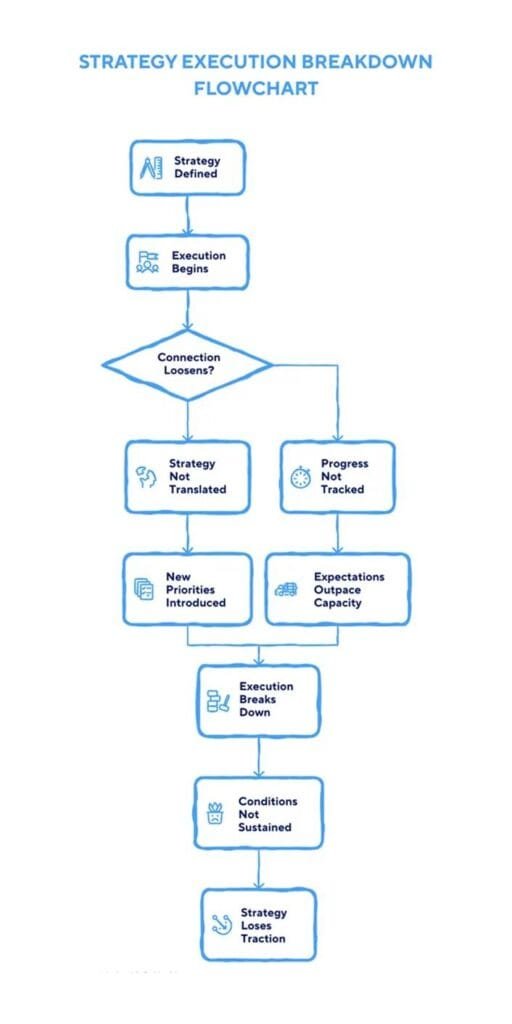
Strategy is not translated into focused work
Execution begins to weaken when strategy is not converted into clear, actionable shifts.
The overall direction may be understood, but what needs to change in day-to-day work is often left unclear. Without that translation, teams continue operating within existing patterns. The strategy exists, but it does not materially influence how work gets done.
At the same time, new priorities are introduced without removing existing ones. Initiatives accumulate, each requiring attention and resources, stretching the organization’s capacity. Effort becomes distributed rather than concentrated, making it difficult for any single priority to gain traction.
Progress is not closely tracked
Early in execution, progress is visible. Milestones are clear and attention is high.
That visibility often fades.
Updates become less precise, and issues take longer to surface. Without consistent tracking, small delays compound into larger gaps. By the time performance is reviewed closely, the distance between expectation and outcome has already widened.
Execution continues, but with less control.
Expectations outpace capacity
Strategies are often built around what the organization aims to achieve, not what it is currently equipped to deliver.
This creates a mismatch between ambition and capacity. Timelines tighten, resources stretch, and teams are asked to deliver at a pace the system cannot sustain.
From one perspective, progress appears slow.
From another, the conditions required for progress were never fully in place.
Execution breaks down when conditions are not sustained
Execution does not fail all at once. It weakens when the conditions required to carry the strategy forward are no longer maintained.
Clarity must hold as work evolves. Focus must be protected as new demands emerge. Progress must be tracked with precision, not assumed. Capacity must match the pace of expectations.
When these conditions hold, execution compounds. When they don’t, even well-defined strategies begin to lose traction.
The issue is not whether the plan was right.
It is whether the organization was able to carry it forward.
Where might there be an opportunity to strengthen those conditions?
———
Sources: